islands define the operating context
BPS context; approximately 17,380 islands in the 2025 referenceProposed national medical aviation network
Partai Rakyat Indonesia
Air Ambulance& Flying Hospital
Persatuan Kristiani Rakyat Indonesia
A national medical aviation network designed for an archipelagic Indonesia.
proposed medical command model
Proposed PERISAI conceptcoordinated response levels
Proposed PERISAI conceptintegrated medical aviation network
Proposed PERISAI concept02
The national challenge
Verified national context
Indonesia Is Not One City. It Is an Archipelago.
The defining healthcare-access problem is not distance alone. It is the accumulated delay between a patient and the right level of care.
The strategic metricTIME TO CARE
Access exists only when the right care can be reached in time.
03
The PERISAI solution
Proposed PERISAI concept
One coordinated response, selected by mission.
PERISAI is proposed as the operating layer between an incident and the right receiving facility—not simply as an aircraft fleet.
Signal 01Patient / incident
Signal 02PERISAI Medical Command
Clinical triage + flight operations + hospital readiness
Ground response
Local ambulance and community care
eVTOL air ambulance
Rapid urban and regional transfer
Fixed-wing medevac
Longer-range inter-hospital missions
N219 medical platform
Proposed amphibious flying-doctor missions
Strategic response
National disaster and surge capability
Clinical handover
Receiving hospital / specialist centre
04
Platform 01 · Urban + regional
Proposed medical configuration
Electric air ambulance.
A proposed medical eVTOL configuration for selected high-acuity transfers, rapid specialist deployment and traffic-constrained urban routes.

P / 01Urban response
The selected aircraft would need to carry the clinical payload without compromising range, reserve energy, weather limits or emergency options.
- Cabin
- Stretcher + medical crew
- Clinical
- Monitor · oxygen · ventilator*
- Digital
- Tracking + telemedicine
- Validation
- OEM + regulator + operator
Current market development · not PERISAI procurement
2026 reporting describes a 30-unit Whitesky–SkyDrive MoU and a separate Whitesky LOI for a planned 60-unit Volant purchase. Both remain subject to certification, regulatory approval, infrastructure readiness, technical evaluation and commercial viability.
See the cited reportsGovernment statementMedical aviation is entering the national capability conversation.
On 3 November 2025, President Prabowo instructed that an air-ambulance module be ordered for the TNI AU A400M. The direction demonstrates growing recognition of air-ambulance capability; it is not proof of a completed module, and it does not endorse or establish a connection to PERISAI.
Review GOV-A400M-0105
Platform 02 · Island + remote
Proposed mission configurations
One aircraft. Multiple medical missions.
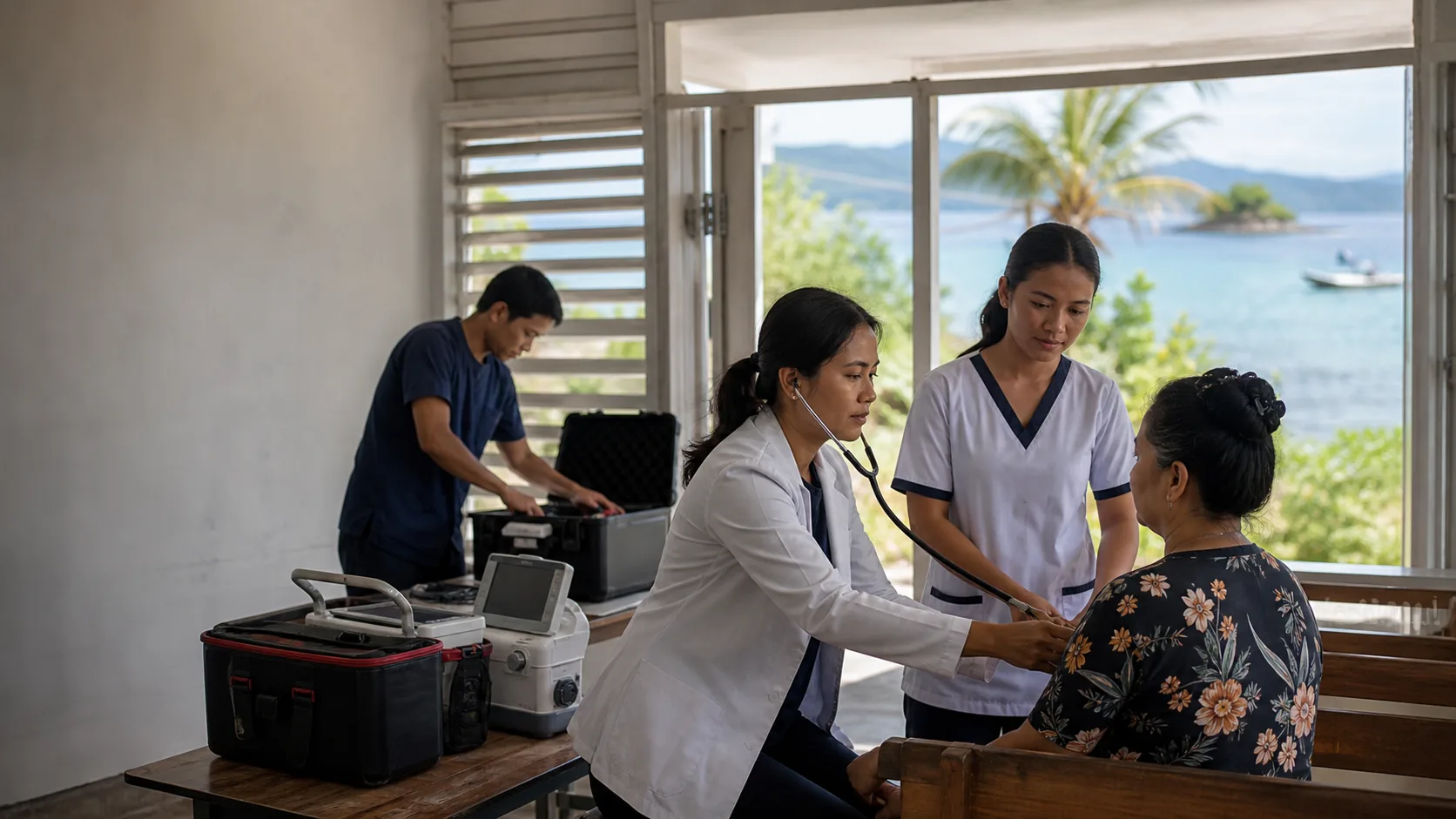
A proposed N219 amphibious medical configuration could bring clinicians, diagnostics and medevac capability to selected locations without conventional airport access.

Flying doctor
Clinicians and portable diagnostics
Medevac
Stretcher and critical-care configuration
Mobile clinic
Consultation and screening stations
Telemedicine
Satellite, cellular and radio links
Disaster response
Medical team, supplies and communications
Maternal + child health
Specialist outreach to remote communities
Public health
Vaccination, screening and disease response
SAR medical support
Clinical support following rescue operations
PTDI describes the N219 as a multi-mission platform and is developing an amphibious variant. PERISAI’s medical modules are a separate proposal; no PTDI partnership or certified medical configuration is implied.
The hospital that flies
The hospital should not always wait for the patient.Sometimes the hospital must fly to the patient.
01
Specialist team
02
Medical command
03
Remote community
04
Diagnosis + stabilization
05
Referral decision
06
Proposed national network
All locations proposed / illustrative
National reach. Regional readiness. Local access.
A proposed hub-and-spoke architecture links tertiary expertise, regional aircraft, local response and remote communities.
Proposed / illustrative network
Planning model onlineToggle a layer, then select any facility marker to inspect its conceptual role.
Map layers
Java
Jakarta
Proposed national command node
- Proposed platform
- Command + multimodal fleet
- Selected planning layer
- Regional hubs
07
Operating model
Proposed PERISAI concept
Every mission is both a clinical decision and an aviation decision.
Aircraft availability alone is not readiness. Medical crew, equipment, weather, landing site and receiving hospital must align.

Medical control Flight operations Network intelligence
08
Decision lab
Illustrative calculations
Model the assumptions. Never hide them.
Explore response time, fleet capacity and economics using transparent, editable assumptions. Outputs are strategic screens—not forecasts, quotes or promised performance.
Response-time simulator
Compare one ground route and one aerial route. This is not a dispatch estimate; weather, launch readiness and landing access can materially change the result.
Ground assumptions
Air assumptions
Potential difference79 minArithmetic difference only — not a promised saving
Ground = distance ÷ average speed + delay. Air = distance ÷ cruise speed + preparation + landing / handover.
09
Mission portfolio
Proposed PERISAI concept
One network, distinct mission realities.
The same command layer can orchestrate very different clinical, geographic and operational pathways.
When physical proximity does not mean timely access.
Compare road and air only with route-specific assumptions for preparation, weather, landing access and hospital handover.
Bring the specialist capability closer.
Flying-doctor assessment can precede—or sometimes avoid—a disruptive evacuation.
Restore clinical reach across disrupted terrain.
Move medical teams, diagnostics, supplies and communications into the response area.
Connect the patient to definitive capability.
Coordinate fit-to-fly, bed acceptance, clinical handover and return-of-care planning.
Conceptual technical architecture
Data + AI
Decision support with human authority at every critical gate.
AI may help prioritise signals, compare routes and surface constraints. It does not diagnose, approve flight or replace the accountable clinician and pilot.
Patient signal
Mobile · call centre · hospital API
Dispatch platform
Triage support · route options
Human control
Medical control · flight operations
Mission
Aircraft · crew · patient tracking
Care handover
Receiving hospital · quality review
10
Proposed deployment
Future targets · not approved
Validate first. Scale through evidence.
Each phase should pass explicit clinical, regulatory, safety, infrastructure and economic decision gates before expansion.
Phase 01
Proof of concept
One or two regional pilotsValidate mission demand, clinical protocols, landing infrastructure and operating economics.
Phase 02
Regional network
Java · Bali · Sumatra · SulawesiConnect selected hospitals, operators and medical aviation hubs with repeatable service standards.
Phase 03
Archipelagic expansion
NTT · Maluku · Kalimantan · PapuaExtend island access with fixed-wing, amphibious and telemedicine-enabled missions.
Phase 04
National medical aviation grid
Integrated national networkCoordinate capacity, data and clinical referral pathways across an interoperable platform.
11
Impact + performance
Proposed KPI framework · no baseline yet
Measure what the network changes.
The pilot should establish verified baselines before targets are approved. The dashboard below defines the measurement system without inventing current performance.
Measurement statusBASELINE REQUIRED
Targets set only after pilot geography, fleet and clinical pathway are validated.
A
Mission control
- Dispatch timeBaseline —
- Mission completionBaseline —
- Aircraft availabilityBaseline —
- Cancellation rateBaseline —
B
Clinical pathway
- Acceptance timeBaseline —
- Stabilization timeBaseline —
- Transfer timeBaseline —
- Clinical handover qualityBaseline —
C
Safety + readiness
- Safety eventsBaseline —
- Crew availabilityBaseline —
- Maintenance releaseBaseline —
- Weather cancellationsBaseline —
D
National impact
- Population coverageBaseline —
- Islands servedBaseline —
- Hospitals connectedBaseline —
- Specialist missionsBaseline —
E
Network economics
- Fleet utilizationBaseline —
- Cost per missionBaseline —
- Contract availabilityBaseline —
- Contribution per missionBaseline —
F
Digital access
- Telemedicine consultsBaseline —
- Data completenessBaseline —
- System uptimeBaseline —
- Referral closureBaseline —
12
Potential strategic partners
Potential ecosystem · no agreements implied
No single institution can build this alone.
The concept requires separate, accountable workstreams across public service, clinical care, aerospace, operations, digital infrastructure and finance.
PERISAIValidated operating program
One mission standard · multiple accountable partners
Public system
Kemenkes · Kemenhub · Bappenas · local government · BNPB · BASARNAS
Healthcare
Hospitals · medical schools · universities · emergency services
Aerospace
PTDI · certified OEMs · operators · MRO · infrastructure providers
Digital
Telecom · satellite · maps · weather · cybersecurity · health technology
Capital + risk
Insurers · banks · investors · assistance companies · corporate clients
Named institutions are shown for ecosystem relevance only. No endorsement, agreement, integration or procurement relationship is claimed.
13
Strategic value
Strategic framing
One proposition. Two decision lenses.
The public-service case and the investment case require different evidence, but they meet in a safe, measurable and scalable operating model.
Government lens
An infrastructure proposition for healthcare equity and resilience.
- 01Connect remote communities to regional and tertiary care
- 02Strengthen disaster-response and surge medical capacity
- 03Develop national aerospace, clinical and digital capability
- 04Support measurable service standards across jurisdictions
Safety + regulation
The pathway is a program, not a footnote.
Regulatory validation must run in parallel with clinical design, infrastructure, fleet selection and financing.
Aircraft certification Operator certification Pilot licensing + training Continuing airworthiness Clinical governance Medical-device compliance Vertiport / helipad approval Water operating zones Battery + fuel safety Weather + reserve policy Privacy + cybersecurity Insurance + liability
Regulatory pathway requires validation with the relevant Indonesian authorities and certified aviation and medical specialists.
Proposed national medical aviation network
No Indonesian should be too far from critical medical care.
Bringing Critical Care to Every Island.
PERISAI is presented as a strategic concept and proposed medical-aviation operating model. Aircraft configurations, routes, fleet numbers, financial assumptions, response times, partnerships, regulatory pathways and operational capabilities are illustrative unless explicitly identified as verified facts. Actual implementation requires aviation certification, medical governance, regulatory approval, aircraft OEM validation, infrastructure development, clinical protocols, insurance and operational partnerships.